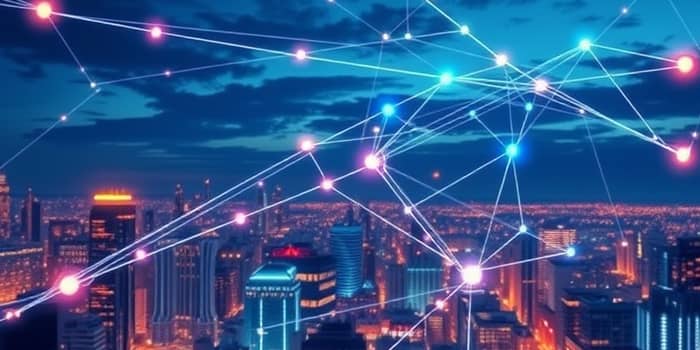
The Semantic Web revolutionizes how organizations share, discover, and repurpose digital assets by embedding meaning directly into data. This transformation promises machine-readable and machine-interpretable content that can power intelligent applications and drive innovation.
Understanding the Semantic Web
At its core, the Semantic Web is an extension of the current World Wide Web where every element of information carries formal metadata that software agents can understand and process. Tim Berners-Lee described it as a “web of data that can be processed directly and indirectly by machines,” enabling computers to navigate a network of facts and relationships much like humans traverse hyperlinked documents.
The evolution of the Web unfolds in three phases. Web 1.0 delivered static pages linked by hyperlinks. Web 2.0 introduced interactive platforms and user-generated content. The next frontier—often called Web 3.0 or the Semantic Web—builds on linked data and meaning to unlock automated integration and reasoning across diverse domains.
To realize this vision, content on the Web is enriched with structured metadata that describes entities, attributes, and context. This metadata is published using universal identifiers (URIs) that ensure each concept or object is referenced unambiguously. As a result, data becomes part of an interconnected fabric rather than isolated silos.
Key Technologies and Standards
The Semantic Web rests on core W3C standards that enable data interoperability and discovery across systems:
- RDF (Resource Description Framework): a graph-based model expressing triples (subject–predicate–object) to represent facts and relationships.
- RDFS and OWL: languages for defining ontologies—formal vocabularies of classes, properties, and logical constraints that support automated inference.
- SPARQL: a powerful query language for extracting and federating data from multiple RDF graphs as if they formed a single dataset.
- URIs/IRIs: unique global identifiers that enable precise referencing of people, places, datasets, and concepts across platforms.
In addition to these, the Linked Data principles outline methods for publishing structured data on the Web so that datasets from different organizations can interlink seamlessly. Knowledge graphs built with RDF and OWL power features such as semantic search, recommendation engines, and AI-driven reasoning that go beyond keyword matching to understand context and intent.
Digital Assets in a Semantic Context
Digital assets encompass any electronically stored resource of value—documents, images, scientific datasets, media files, IoT streams, and more. Traditionally, these assets reside in application-specific silos, governed by proprietary schemas that limit sharing and reuse.
The Semantic Web redefines these assets as first-class entities in a knowledge graph. Each asset is assigned a URI and described using shared ontologies that capture its type, provenance, usage rights, version history, and relationships to other resources. This approach ensures assets are self-describing digital assets through ontologies, making them discoverable and reusable by unknown systems.
- FAIR principles (Findable, Accessible, Interoperable, Reusable) drive the design of research data repositories using semantic profiles.
- FAIR Digital Objects leverage layered ontologies to standardize metadata across scientific domains.
- Decentralized identifiers (DIDs) and verifiable credentials expressed in RDF allow portable identities and attestations for assets across ecosystems.
By embedding rich metadata, the Semantic Web elevates any digital item into a node within an interconnected graph, enabling automated workflows, provenance tracking, and dynamic access control.
Achieving Data and Semantic Interoperability
Syntactic interoperability ensures systems agree on formats (JSON, XML, HTTP) but often fails to preserve meaning. Semantic interoperability bridges that gap by guaranteeing that shared data carries the same interpretation across diverse platforms. This is critical when terms like “HbA1c” and “Glycated Hemoglobin” must be treated identically in healthcare analytics.
Successful semantic interoperability relies on interoperability frameworks that preserve meaning through:
- Data models defining entity structures and attributes.
- Ontologies offering shared conceptualizations of domains.
- Vocabularies with controlled terms and definitions.
- Semantic mappings linking heterogeneous schemas and vocabularies.
Frameworks such as DCAT-AP+ for research catalogs and domain-specific profiles (e.g., ChemDCAT-AP) demonstrate how harmonized metadata can unify discovery and integration efforts across institutions. Engineering and AEC sectors use ontologies like EMMO to align product models and materials data, facilitating complex simulations and supply chain coordination.
Concrete Use Cases, Metrics, and Challenges
The Semantic Web serves as an interoperability fabric for numerous scenarios:
- Data integration: federated SPARQL queries combine records from disparate islands into a unified view.
- Data migration: declarative mapping tools translate XML or relational exports into RDF without losing contextual meaning.
- Enterprise knowledge graphs: break silos, enabling cross-system analytics, pattern discovery, and AI-driven decision support.
Real-world deployments highlight both the promise and challenges of this vision. In healthcare, semantic interoperability accelerates research by harmonizing patient records and lab results. In manufacturing, knowledge graphs optimize production planning by linking machine data, design specifications, and supplier catalogs. Academic repositories reduce duplication and boost reproducibility through FAIR Digital Objects.
Yet obstacles remain: aligning disparate ontologies demands expert curation; performance can suffer when graphs scale to billions of triples; governance and standard adoption require cross-industry collaboration. Overcoming these hurdles necessitates both technical innovation and organizational commitment to open standards.
Looking Forward: The Future Fabric of Interoperability
The Semantic Web’s promise lies in its ability to transform raw data into an intelligent network of knowledge, empowering automated agents to orchestrate complex tasks, discover hidden insights, and bridge disciplinary boundaries. As organizations adopt shared ontologies and expose their assets as linked data, the global web of information will evolve into a living ecosystem of collaboration and innovation.
By embracing the Semantic Web, enterprises and communities unlock a new era of digital asset management and unified view across disparate data silos. The result is a resilient, adaptive infrastructure where data flows freely, insights emerge organically, and collective intelligence flourishes.
References
- https://www.techtarget.com/searchcio/definition/Semantic-Web
- https://www.graphapp.ai/engineering-glossary/cloud-computing/semantic-interoperability-frameworks
- https://www.ontotext.com/knowledgehub/fundamentals/what-is-the-semantic-web/
- https://flur.ee/fluree-blog/semantic-interoperability-exchanging-data-with-meaning/
- https://www.tutorialspoint.com/semantic-web-definition-applications-and-benefits
- https://www.emergentmind.com/topics/semantic-interoperability-models
- https://graphwise.ai/fundamentals/what-is-semantic-web-and-semantic-technology/
- https://www.semaphoresolutions.com/post/powering-interoperability-in-lab-informatics-with-the-semantic-web
- https://codeinstitute.net/global/blog/the-semantic-web/
- https://www.energy.gov/eere/buildings/semantic-modeling-and-interoperability
- https://en.wikipedia.org/wiki/Semantic_Web
- https://odeco-research.eu/?p=2770
- https://www.w3.org/RDF/Metalog/docs/sw-easy
- https://pmc.ncbi.nlm.nih.gov/articles/PMC8791650/