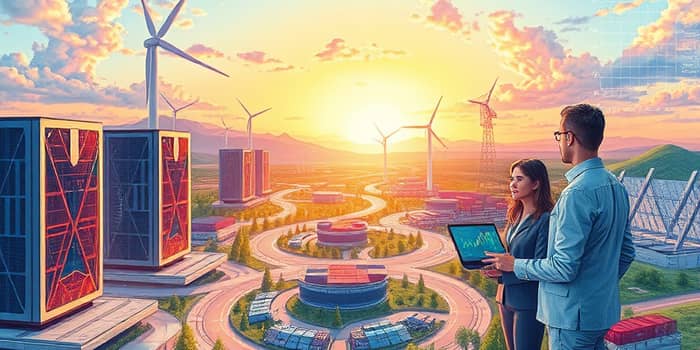
As we stand at the threshold of 2026, investors face a rapidly evolving world where technology, geopolitics, and sustainability intersect. Navigating this complex environment demands a deep understanding of emerging trends, strategic foresight, and a willingness to embrace innovation. This article illuminates key themes, regional opportunities, and risk management strategies to help you chart a resilient investment course.
Emerging Themes Shaping Tomorrow’s Growth
The global economy is at an inflection point driven by four core forces: economic security, AI diffusion, energy transition, and societal shifts. Each theme offers unique pathways for capital deployment and demands an adaptive mindset.
1. Economic Security: Reinforcing Foundations
Amid rising geopolitical tensions and trade realignments, companies prioritize resilient and reliable supply networks over pure cost efficiency. Governments are investing heavily to secure critical resources and bolster national defense, creating opportunities across infrastructure, defense contractors, and resource extraction.
Key drivers include:
- Geopolitical flashpoints and NATO defense commitments in Europe and North America
- Reindustrialization efforts supported by tariffs and domestic incentives
- Demand for shorter supply chains with built-in flexibility and risk mitigation
With China accounting for 60% of rare earth production and Taiwan manufacturing 90% of leading-edge semiconductors, shifts in global trade flows are redefining winners and losers. Investors can explore companies that offer pick-and-shovel solutions—from advanced chip equipment makers to specialized logistics providers.
2. AI and Technology Diffusion: The New Engine of Growth
AI-driven innovation continues to reshape industries. While US mega-cap tech remains dominant, capex cycles are expanding to China, India, Europe, and Japan. Diversifying across regions and sub-themes reduces concentration risk and harnesses broader upside potential.
Hyperscalers are racing to deploy infrastructure, making AI-driven capex remains central to global growth. This translates into significant demand for data centers, semiconductors, and high-voltage power equipment.
As data centers consume 3% of US power today—and could rise to 8% by 2030—renewable energy providers and grid-enhancement specialists are poised to benefit. Investors should consider companies offering integrated power solutions, from energy storage to microgrid technologies.
3. Energy Transition: Balancing Maturity and Innovation
The clean energy landscape is maturing. Renewables, energy storage, and grid modernization commands high investment priority, while hydrogen and carbon capture technologies face slower adoption.
- Renewable energy: Solar, wind, and hydro capacity expansion
- Energy grids: Smart grid upgrades and transmission enhancements
- Energy storage: Battery manufacturing and advanced materials
Successful strategies blend low-carbon power generation with transport electrification and digital grid management. Companies that deliver substantial cost savings without relying on subsidies stand out in a higher-inflation environment.
Sustainable Investing Evolution: Performance Takes Center Stage
The sustainable investing narrative has shifted from labels to actionable outcomes. Investors now demand performance-focused metrics and themes that address real-world challenges—circular economy, disaster resilience, and efficient resource utilization.
Key categories include:
- Circular economy solutions that keep materials in use and eliminate waste
- Physical risk mitigation firms offering flood defenses, resilient infrastructure, and adaptive agriculture
- Private credit for non-dilutive financing in energy transition projects
With nearly $1 trillion spent on disaster recovery in the US alone last year—and prevention budgets lagging—companies specializing in adaptation and resilience present compelling opportunities.
Regional Opportunities and Global Outlook
While global GDP growth is expected to moderate to 3% in 2026, robust capex, fiscal support, and reduced tariff uncertainty underpin a resilient outlook.
United States: A resilient labor market and sustained AI-driven investment support a forecasted 2.5% GDP growth. However, concentration in mega-cap tech calls for selective exposure to cyclicals in industrials and financials.
Europe: An uptick in military and infrastructure spending—€800 billion in defense commitments—combined with potential rate cuts, creates fertile ground in domestic-focused small-to-mid-cap equities and euro-denominated credit.
Emerging Markets: Strong demographics, favorable monetary easing, and a weaker dollar boost EM stocks. China’s AI investments and India’s reform momentum further enhance regional appeal.
Managing Risk and Positioning Your Portfolio
Investors should adopt a mildly pro-risk stance, balancing growth exposure with strategic hedges. Key vulnerabilities include equity concentration, rising public debt, and sticky inflation from reshoring and energy transition costs.
Recommended approach:
Conclusion: Charting a Resilient Investment Course
In a multipolar world marked by controlled disorder, investors who embrace innovation, prioritize resilience, and maintain disciplined risk management stand to thrive. By aligning portfolios with core themes—economic security, AI diffusion, energy transition, and sustainable solutions—you can navigate uncertainty and capture long-term value.
Seize the moment: blend traditional assets with thematic exposures, harness private capital opportunities, and remain vigilant to geopolitical shifts. Your journey along these profitable pathways begins with research, execution, and the conviction to adapt as the world evolves.
References
- https://am.gs.com/en-hk/advisors/insights/article/investment-outlook/megatrends-thematic-investing-2026
- https://research-center.amundi.com/article/2026-investment-outlook
- https://www.invesco.com/us/en/insights/global-investment-outlook.html
- https://www.morganstanley.com/insights/articles/investment-outlook-shaping-markets-2026
- https://www.aberdeeninvestments.com/en-gb/professional/insights-and-research/8-issues-that-will-define-the-investment-landscape-in-2026
- https://www.lseg.com/en/ftse-russell/research/2026-sustainable-investment-trends
- https://www.youtube.com/watch?v=Ftll09wVZUg