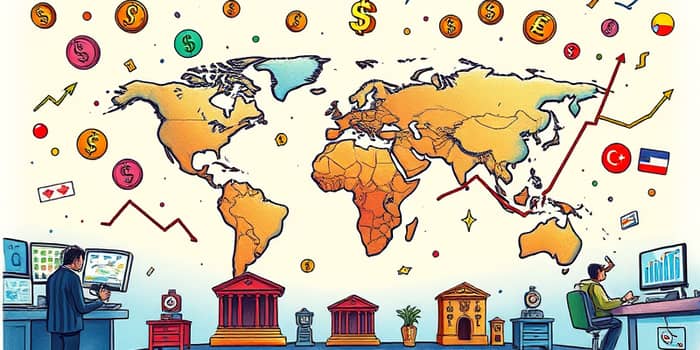
Currency markets respond to a complex web of economic forces, policy decisions, and global events. Understanding these drivers can empower traders and investors to make informed decisions.
Introduction to Forex Fundamentals
Fundamental analysis involves studying economic components that shift sentiment and drive currency demand. Unlike technical analysis, which focuses on price patterns, fundamentals provide a long-term currency trends perspective.
By examining indicators, monetary policy and intermarket correlations, traders can anticipate directional moves and align strategies with broader economic shifts.
Key Economic Indicators
Major economic releases often trigger significant currency moves. The following table summarizes their descriptions and typical impacts.
Interest Rates and Central Banks
Central banks wield immense influence by adjusting benchmark interest rates and deploying tools like quantitative easing. Rate hikes draw foreign investment, while cuts can trigger outflows and depreciation.
Forward guidance also shapes forward-looking investment decisions, as traders price in expected policy paths months in advance.
- Carry trade strategies capitalize on rate differentials, borrowing in low-yield currencies to invest in high-yield ones.
- Quantitative easing increases money supply and often weakens the issuing currency.
- Monetary policy surprises can spark rapid volatility spikes.
Intermarket Correlations
Currencies rarely move in isolation. Equities, bonds and commodities influence FX through portfolio rebalancing and risk preferences.
- Commodities: Oil-exporting currencies like CAD rally when crude prices rise.
- Equities: Risk-on environments often weaken safe-havens like the USD and JPY.
- Bonds: Rising yields in government debt can attract flows, bolstering associated currencies.
Recognizing these volatility-driven trading opportunities helps traders anticipate cross-market reactions under shifting conditions.
Political and Geopolitical Events
Elections, trade disputes and natural disasters can rapidly alter economic outlooks and currency valuations. Key historical examples include:
- Brexit referendum in June 2016 sent GBP from $1.50 to below $1.30 within days.
- 2016 U.S. presidential election volatility created safe-haven USD rallies.
- OPEC production decisions influence oil price swings and impact exporters like CAD.
Traders must assess policy risks and political calendars to manage event-driven exposures effectively.
Real Exchange Rates and Equilibrium
The real exchange rate adjusts the nominal FX rate for inflation differentials, reflecting purchasing power. Persistent deviations from long-term mean levels can signal overvaluation or undervaluation.
Purchasing power parity adjustments tend to correct extreme misalignments over time, providing opportunities for mean-reversion strategies.
Market Size and Volatility Context
The global FX market trades over $6 trillion daily, making it the largest financial arena. High turnover ensures liquidity, but major announcements can still generate sharp moves.
Periods of elevated volatility often coincide with data releases and central bank meetings. Understanding typical ranges and historical reactions can guide position sizing and risk management.
Impacts on Trading Performance
By integrating fundamental insights, traders can refine strategies across time horizons. Some practical applications include:
- Pair selection based on interest rate differentials and economic growth prospects.
- Hedging corporate exposures using forwards and options to lock in exchange rates.
- Carry trades with appropriate leverage and risk controls to capture yield spreads.
Combining fundamental signals with technical entries can enhance the probability of success and improve risk-adjusted returns in currency portfolios.
Real-World Case Studies
Examining past events brings theory to life. Consider these illustrations:
1. GBP/JPY surged when the Bank of England unexpectedly hiked rates in August 2018. Traders exploiting the negative-yielding JPY borrowed cheaply to buy GBP, driving the pair northward.
2. The CAD/OIL relationship deepened after 2020 as vaccine optimism lifted energy demand. Rising crude prices fueled CAD appreciation against major peers.
3. USD strength in 2022 reflected divergent rate paths as the Federal Reserve accelerated tightening while other central banks hesitated.
Conclusion: Synthesizing Fundamentals for Traders
A comprehensive grasp of economic indicators, policy shifts and intermarket dynamics empowers traders to anticipate currency moves rather than merely react to price swings. By weaving together real exchange rate analysis, capital flow trends and event risk assessments, market participants can construct robust strategies tailored to global economic cycles.
Adopting a disciplined approach that respects both macro fundamentals and technical confirmations will enhance decision-making and support long-term trading success.
References
- https://www.youtube.com/watch?v=frzjivWWYGE
- https://www.oanda.com/us-en/trade-tap-blog/asset-classes/forex/how-other-assets-affect-foreign-exchange-market/
- https://www.imf.org/en/publications/fandd/issues/series/back-to-basics/real-exchange-rates
- https://www.ig.com/en/trading-strategies/how-to-predict-forex-movements-200717
- https://www.babypips.com/learn/forex/long-term_market_movers
- https://www.straitsfinancial.com/insights/forex-market-impact-how-global-events-affect
- https://www.forexearlywarning.com/forex-lessons/forex-fundamental-analysis
- https://www.tradu.com/en/guide/forex/what-drives-forex-prices/
- https://www.schwab.com/learn/story/foreign-exchange-forex-trading-beginners
- https://www.bis.org/publ/qtrpdf/r_qt2212f.htm
- https://www.ifcci.org.my/courses/learn-forex-course-06/lessons/fundamental-factors-that-affect-currency-values/
- https://www.juliusbaer.com/en/insights/wealth-insights/how-to-invest/how-do-currencies-affect-your-investments/