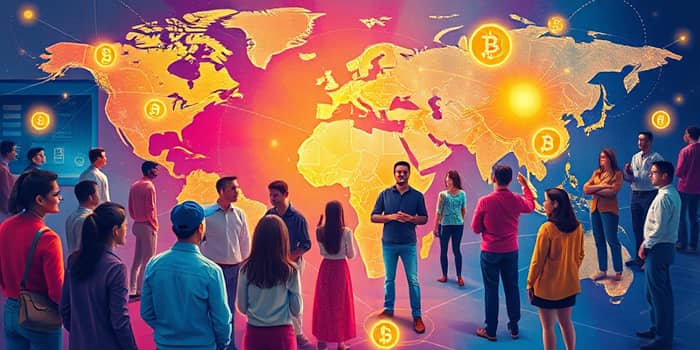
In this article, we explore the origins, core principles, practical guidance, and future outlook of DeFi. Whether you’re a curious newcomer or an experienced technologist, you’ll find actionable insights to navigate the emerging world of decentralized finance.
What Is DeFi?
DeFi stands for decentralized finance—a collection of blockchain-based protocols that replicate or surpass traditional financial products without intermediaries like banks. At its heart are self-executing smart contracts that automatically enforce agreements, and user-controlled digital wallets that ensure robust self-custody options available.
Transactions occur on permissionless networks such as Ethereum, where transparency and immutability guarantee that all actions are recorded on an append-only ledger. This lays the foundation for open access and near-instant speed and transparency in settlement processes.
The Evolution of Financial Systems
The path to DeFi began with Bitcoin’s launch in 2009 and accelerated with Ethereum’s introduction of smart contracts in 2015. By August 2018, Ethereum developers coined the term “DeFi” during a Telegram chat, giving a name to a growing ecosystem of decentralized applications.
Over time, the DeFi movement fostered a global community of developers and users, building open-source composability and interoperability that allow one protocol to integrate seamlessly with another—often called “money Legos.”
Key Features Driving DeFi
- Decentralized and permissionless networks: Anyone can participate without needing approval or verification.
- Immutable and transparent records: All transactions are publicly verifiable on-chain.
- Composable smart contracts: Protocols can be combined to create new, innovative services.
- Pseudonymous global access: Users transact under privacy-preserving pseudonyms.
- Self-custody control: Individuals hold their own private keys, eliminating custodial risk.
Comparison: DeFi, CeFi, and TradFi
Understanding how DeFi contrasts with centralized finance (CeFi) and traditional finance (TradFi) highlights its transformative potential.
How DeFi Challenges Traditional Finance
By removing intermediaries, DeFi reduces costs and settlement times while enabling unprecedented global financial inclusion opportunities. It operates 24/7, fosters rapid innovation cycles, and empowers users to build tailor-made financial products.
Open-source protocols invite developers to experiment, auditors to verify code, and communities to govern projects through token-holder voting. This collaborative model democratizes finance and sets the stage for a more resilient, user-centric ecosystem.
Practical Steps to Engage Safely with DeFi
- Choose a reputable self-custody wallet (e.g., MetaMask, Ledger).
- Start with small amounts to understand gas fees and network behavior.
- Use audited protocols and review community feedback.
- Diversify risk by exploring multiple platforms and assets.
- Stay informed about local regulations and tax implications.
Risks to Navigate
While DeFi offers many benefits, it also carries inherent risks. Smart contract vulnerabilities can lead to hacks, and users face irreversible losses if private keys are lost. Regulatory uncertainty may affect protocol operations or accessibility in certain regions.
Other challenges include market volatility, impermanent loss in liquidity pools, and network congestion leading to high gas fees. Understanding these factors and adopting best practices is crucial for a secure DeFi journey.
Future Trends and Outlook
The long-term success of DeFi depends on cross-chain interoperability, bringing greater liquidity and efficiency. Emerging layer-2 solutions and alternative blockchains aim to address scalability and cost barriers, while hybrid models may integrate CeFi security measures with DeFi’s open ethos.
Experts foresee the rise of institutional DeFi, standardized compliance frameworks, and novel financial instruments that bridge real-world assets with digital ledgers. As protocols mature and regulations adapt, the promise of a transparent, accessible, and programmable global financial system comes closer to reality.
References
- https://www.trmlabs.com/glossary/decentralized-finance
- https://www.weforum.org/stories/2025/10/decentralized-finance-financial-markets-in-practice/
- https://en.wikipedia.org/wiki/Decentralized_finance
- https://gocardless.com/en-us/guides/posts/what-is-decentralized-finance/
- https://www.coinbase.com/learn/crypto-basics/what-is-defi
- https://www.federalreserve.gov/econres/feds/decentralized-finance-defi-transformative-potential-and-associated-risks.htm
- https://www.fidelity.com/learning-center/trading-investing/crypto/decentralized-finance-defined
- https://www.santanderbank.com/w/understanding-decentralized-finance
- https://fcnb.ca/en/guides/what-is-defi-and-how-does-it-work
- https://surmount.ai/blogs/defi-explained-should-you-use-decentralized-finance
- https://www.bis.org/publ/work1066.htm
- https://www.bostonfed.org/publications/risk-and-policy-analysis/2022/decentralized-finance-defi-transformative-potential-and-associated-risks.aspx
- https://www.youtube.com/watch?v=mg7NTX_3_2o