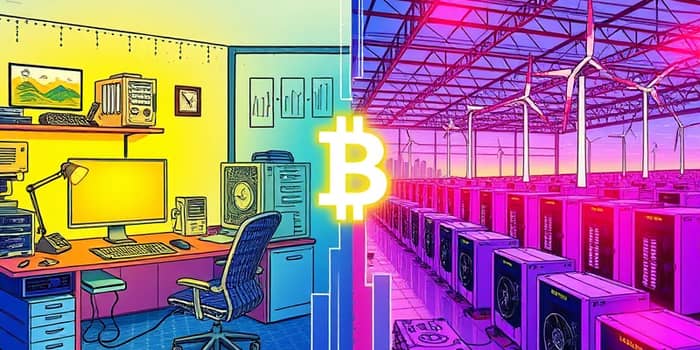
Cryptocurrency mining has undergone a remarkable transformation in less than two decades. What began as a solo endeavor on personal computers has matured into a strategic, institutional-scale industry shaping global finance and energy markets.
Historical Evolution: From Hobby to Professionalization
In 2009, Bitcoin sparked a revolution, inviting enthusiasts to mine coins with everyday CPUs and GPUs. The low network difficulty made solo mining not only possible but often profitable.
By 2013, the landscape shifted dramatically when groundbreaking ASIC hardware introduction made general-purpose rigs obsolete. Miners pooled resources to stay competitive, and small operators began to withdraw.
Today, mining has fully professionalized. Large firms deploy thousands of ASIC units across multiple continents, benefiting from economies of scale and advanced cooling strategies.
- Early hobby phase with CPU/GPU miners
- Rise of ASICs and mining pools
- Institutional entry and global expansion
Bitcoin Supply and Mining Mechanics
Bitcoin remains unique with its 21 million BTC cap, enforced by code. As of 2026, over 19.68 million coins have been mined, leaving less than 7 percent to be released through future block rewards.
Every 10 minutes, miners compete to validate transactions via proof of work. Rewards consist of new coins plus transaction fees, adjusting difficulty every two weeks to maintain consistency.
Market Size, Growth, and Projections
By 2026, the global crypto mining market reached an estimated USD 3.12 billion. Analysts forecast expansion to USD 9.18 billion by 2035, driven by institutional adoption and demand for blockchain transparency.
Key growth factors include regulatory clarity, energy cost arbitrage, and strategic investments from venture capital firms.
- Hardware and software offerings
- Service models like cloud mining and MaaS
- Regional leaders with cheap renewable energy
Technological Advancements and Efficiency Trends
ASIC efficiency has doubled in recent years, with top machines now operating below 10 joules per terahash. Older models retire unless powered by ultra-low electricity costs below three cents per kilowatt-hour.
Miners are also diversifying. Many repurpose facilities for AI and high-performance computing workloads when profitability dips.
- Vertical integration to reduce operational costs
- AI data centers filling idle capacity
- Cloud mining services expansion
- National strategies to attract mining investment
- Financialization via public listings and tokenized equity
- Exit of obsolete hardware in efficiency arms race
- Focus on heat reuse and demand response
Sustainability and Energy Solutions
Environmental scrutiny has pushed the industry toward greener practices. Over half of global mining now relies on hydro, wind, or solar power, turning stranded energy into revenue.
Innovations such as waste heat utilization systems and participation in grid balancing programs help stabilize electricity networks and improve public perception.
Regulatory Landscape and Global Context
Government approaches vary widely. The United States offers favorable conditions with decentralized grids and incentives for clean energy. Brazil and India explore frameworks to foster growth, while Russia has tightened controls.
Legislation such as the US H.R.3633 bill aims to establish clear digital asset rules, reducing uncertainty for both miners and investors.
Challenges and Future Outlook
Profits remain under pressure. The hashprice squeeze—driven by higher difficulty and fluctuating coin values—has tested margins, leading to industry consolidation.
Nevertheless, opportunities abound. Strategic miners leverage renewable energy sources, explore cloud mining partnerships, and plan for the post-2140 era when transaction fees will secure the network.
As we look ahead, mining stands poised to integrate further with global energy and financial systems, continuing its evolution from a niche hobby to a cornerstone of modern infrastructure.
References
- https://www.jbs.cam.ac.uk/faculty-research/centres/alternative-finance/publications/cambridge-digital-mining-industry-report/
- https://www.bleap.finance/blog/how-many-bitcoins-are-left-to-mine
- https://www.precedenceresearch.com/cryptocurrency-mining-market
- https://www.indexbox.io/blog/bitcoin-mining-profitability-hits-14-month-low-amid-price-drop-and-winter-storm/
- https://www.tradingkey.com/analysis/cryptocurrencies/btc/261582943-bitcoin-miners-aisolo-mining-stocks-discontinues-cloud-legit-bonus-tradingkey
- https://www.kucoin.com/news/flash/bitcoin-mining-2026-outlook-seven-trends-defining-the-industry
- https://bitcoinminingstock.io/blog/bitcoin-mining-stocks-explained-2026-guide/
- https://www.nicehash.com/blog/post/how-bitcoin-miners-can-stay-profitable-in-2026
- https://minesandmoney.com/news/industry/ten-major-mining-tech-trends-in-2026-part-1
- https://buybitcoinworldwide.com/bitcoin-mining-statistics/
- https://www.whitecase.com/insight-our-thinking/mining-metals-2026-adapting-policy-driven-business-cycle
- https://www.congress.gov/bill/119th-congress/house-bill/3633/text/ih