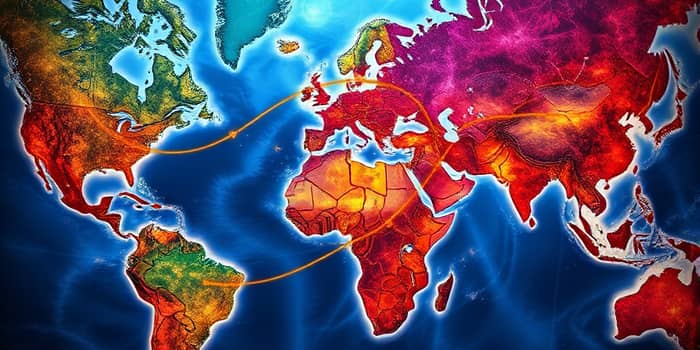
As 2026 unfolds, investors face a world no longer defined by a single hegemon but by competing centers of power and diverging policies. The era of seamless globalization has given way to a landscape where national interests, security concerns, and regional blocs drive markets. Savvy investors can thrive by understanding these shifts and positioning portfolios to harness emerging trends.
From U.S. interventionism to China’s industrial overcapacity, this article explores the forces reshaping supply chains, trade dynamics, and capital flows. We identify key hotspots, assess risks, and outline actionable strategies to generate alpha amid uncertainty.
Death of Globalization and Rise of Nationalism
Gone are the days of unfettered cross-border integration. Instead, new economic nationalism reshaping markets has become the norm. Governments worldwide are deploying tariffs, export controls, and procurement bans to secure critical industries and protect domestic jobs.
In 2026, the United States has blended interventionism with dealmaking, redefining state-market relations. Europe responds with its own measures against China’s overcapacity in electric vehicles, wind components, and semiconductors. Latin America swings right, embracing market-friendly reforms after years of leftist disappointment. These developments mark a clear departure from the post–Cold War consensus.
Power Shifts Shaping Global Investment
The global order is fragmenting into competing spheres. Traditional alliances endure, but middle powers and tech giants are asserting autonomy. Decisions on climate policy, health security, and AI governance now reflect a polycentric power structures taking shape. For investors, identifying which centers will drive growth is paramount.
Emerging Hotspots for Investors
Certain regions and sectors offer compelling growth potential as governments recalibrate priorities. From critical minerals to regional manufacturing hubs, understanding where capital is flowing can yield significant returns.
- Critical minerals alliances in North America and Europe to secure lithium, cobalt, and rare earths.
- Latin American markets benefitting from deregulation and foreign investment incentives.
- Asia’s defense and technology sectors backed by rising budgets in Japan, Korea, and India.
Investor attention should also turn to reshoring initiatives. Companies are building resilient supply chains closer to home, driving demand for domestic manufacturing, robotics, and automation technologies.
Navigating Risks and Opportunities
The shifting geopolitical landscape brings new threats as well as openings. Trade wars, alliance strains, and overcapacity in strategic industries can create volatility—but they also uncover mispriced assets and novel niches.
- Risks from trade wars and overcapacity in semiconductors and renewable energy components.
- Currency fragmentation and tech backlash complicating cross-border transactions.
- Democracy’s erosion in key markets undermining policy predictability.
By staying ahead of policy moves and diversifying exposures across geographies, investors can hedge downside while capturing upside from government-led spending and incentives.
Strategies for Savvy Investors
1. Derisk from China: Build exposure in allied jurisdictions processing critical minerals and manufacturing advanced components.
2. Embrace regionalization: Align with regional blocs like USMCA, EU trade partnerships, and ASEAN production networks for stable growth.
3. Seek thematic playbooks: Focus on minerals, defense technology, and AI infrastructure, sectors underpinned by selective and transactional U.S. leadership and allied collaboration.
- Develop a modular portfolio to reallocate capital swiftly as geopolitical flashpoints emerge.
- Invest in companies with diversified supply chains and strong government ties.
- Monitor policy indicators—tariff announcements, export controls, procurement rules—for early signals.
Successful navigation of 2026’s maelstrom requires a blend of macro insight and sector expertise. Investors who can synthesize intelligence on trade, security, and technology will be best positioned to generate alpha.
Conclusion: Charting a Course Through Uncertainty
We stand at the cusp of a truly fragmented era of great power competition. While uncertainty abounds, the coming years will reward those who anticipate shifts and adapt strategies accordingly. By capitalizing on opportunities in critical minerals chains and aligning with resilient regional blocs, investors can ride the wave of transformation rather than be swept aside.
Embrace the complexity. Build diversified, agile portfolios. And remember that in a world of competing centers of power, insight and flexibility are the ultimate competitive advantages.
References
- https://www.michiganfarmnews.com/how-a-shift-to-regionalism-will-impact-us-trade-markets
- https://www.lazard.com/research-insights/top-geopolitical-trends-in-2026/
- https://www.brookings.edu/articles/is-trump-reshaping-the-world-order/
- https://www.weforum.org/stories/2026/02/four-risk-trends-shaping-the-planet/
- https://www.youtube.com/watch?v=FPdw_kSx_mA
- https://www.newyorklifeinvestments.com/global-markets/geopolitics
- https://www.government.se/statements/2026/02/statement-by-prime-minister-ulf-kristersson/