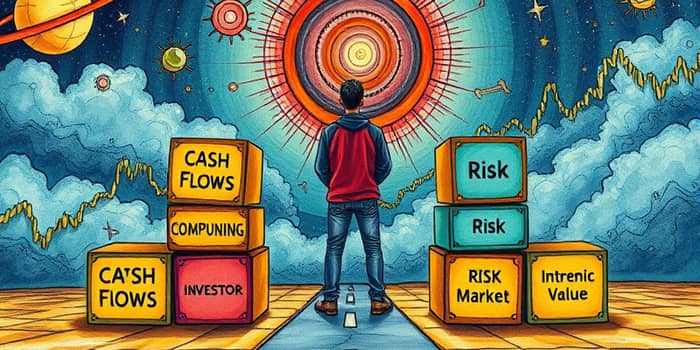
In a world of complex financial products and endless market noise, mastering the art of investing begins by revisiting the basics. This article guides you through a transformative approach rooted in foundational truths, enabling you to craft strategies that stand the test of time. By dissecting investments to their core elements and rebuilding with clarity and discipline, you can uncover resilient opportunities and navigate uncertainty with unwavering confidence.
At its heart, first principles thinking encourages us to break down investments to their most fundamental truths—undeniable facts such as cash flows, intrinsic value and risk dynamics. Originating from Aristotle’s definition of foundational knowledge in 350 BC, this method has empowered scientists and engineers to innovate. When applied to markets, it strips away assumptions, analogies and hype, exposing the building blocks for rational decision-making and long-term growth. By challenging assumptions, you develop mental models that endure shocks and reduce susceptibility to market fads.
Understanding First Principles Thinking
First principles thinking is not about following conventional wisdom or mimicking historical patterns. Instead, it demands relentless questioning of every assumption and reconstructing ideas based solely on empirical evidence and logical deduction. Investors who embrace this mindset learn to identify what truly drives value, from baseline returns to behavioral safeguards, rather than relying on anecdotes or popular sentiment.
By focusing on fundamental metrics—discounted cash flows, management quality and competitive advantages—you create a robust framework that endures market cycles. This approach promotes agility, as you continuously test and refine your hypotheses against evolving data, ensuring your strategies remain grounded in objective reality rather than fleeting trends or emotional impulses.
Core Principles of Investing
Drawing from extensive investor analyses, the following foundational truths serve as the pillars of first principles investing. Each principle offers a precise lens through which to evaluate assets and construct portfolios with purpose and resilience.
- Money generation: It takes money to make money.
- Buy low, sell high: Capitalize on price discrepancies.
- Compounding: Returns multiply when not withdrawn.
- asymmetric losses demand extra caution: A 50% loss needs a 100% gain to break even.
- Intrinsic value: Net present value of future cash flows.
- Speculative assets: No cash flows, driven solely by supply and demand.
- Diversification: Reduces performance variance across holdings.
- Risk premium: Extra reward required for risk exposure.
- Baseline return: At least the cost of capital.
- Real returns: Nominal return minus inflation.
- Behavioral safeguards: Discipline, policies and systems to counter biases.
- No risk-free assets: All investments carry some risk.
- Price dynamics: Strong fundamentals can become value traps.
- True value: Independent of market price fluctuations.
- Purpose of investing: Profitable returns tested quantitatively.
First Principles vs. Pattern Recognition
While first principles thinking deconstructs opportunities from fundamental truths, pattern recognition relies on historical analogies and past experiences. Both approaches offer unique benefits: rigorous insight from foundational analysis and contextual guidance from historical data. By understanding the limitations and strengths of each, you can blend them to build strategies that are both innovative and prudent.
Real-World Case Studies
Real investors and innovators have leveraged first principles thinking to redefine industries. Elon Musk’s SpaceX famously questioned rocket cost structures and discovered raw materials account for just 2% of total expenses. By challenging the norm of single-use rockets and iterating through rapid prototyping, the company pioneered reusability, slashing launch costs, improving reliability and accelerating space exploration at an unprecedented cadence.
Under Satya Nadella’s leadership, Microsoft underwent a cultural transformation focused on empathy, collaboration and continuous learning. By reassessing core assumptions about product development, cloud strategy and customer engagement, the company’s market value soared from $750 billion to over $1 trillion by 2019. Integrating cross-platform services and open innovation, Microsoft demonstrated how purpose-driven management can unlock exponential growth.
Other strategic investors and leaders—such as NVIDIA’s Jensen Huang, the Verdad Capital strategy and Halo Investing—systematically test fundamental hypotheses using quantitative backtesting, emphasize low fees and maintain disciplined processes. Their success underscores the universal applicability of first principles across sectors and scales, from technology giants to specialized equity funds.
Building a Resilient Portfolio
Translating foundational truths into actionable portfolios involves clear goals, cost management and robust risk controls. Emphasize simplicity and broad exposure to reduce hidden correlations and unexpected drawdowns. By prioritizing core principles, you position your investments to capture market gains while guarding against severe losses. Regularly backtest scenarios to validate assumptions and adjust allocations proactively.
- Diversify across asset classes, sectors and geographies.
- Minimize fees and transaction costs for net efficiency.
- Maintain liquidity buffers to seize opportunities and weather downturns.
- compounding power drives exponential growth when returns are reinvested over time.
- Implement stop-loss measures and position sizing to cap downside.
Cultivating an Innovative Investing Mindset
Beyond technical frameworks, adopting a creative and disciplined mindset is crucial. Approach each investment with childlike curiosity, question inherited wisdom and embrace stoic discipline to weather market volatility. Embed clear policies, checklists and performance reviews to counter cognitive biases and ensure consistency in decision-making.
- test every assumption like a scientist before allocating capital.
- Blend unrelated ideas to spark fresh insights.
- Prioritize long-term vision over short-term market noise.
- Embed ethical practices and social impact into every decision.
Investing from first principles is more than a strategy—it is a transformative journey that reshapes how you perceive markets and seize opportunities. By anchoring decisions in undeniable truths, rigorously testing hypotheses and nurturing a growth-oriented mindset, you cultivate resilience, adaptability and the confidence to thrive in any environment. Embrace the challenge, dismantle complexity and build investment frameworks that stand resilient against the tides of uncertainty.
References
- https://portfoliothinktank.com/first-principles-of-investments/
- https://www.brainzmagazine.com/post/first-principal-thinking-case-studies
- https://contrarianvalueedge.notion.site/First-Principles-vs-Pattern-Recognition-in-Investment-decisions-1c7dc8239324807cadd1e1dc3adb5278
- https://pressroom.aboutschwab.com/press-releases/press-release/2023/Experienced-Investors-Point-to-Timeless-Principles-as-Keys-to-Long-term-Investing-Success-and-Satisfaction/default.aspx
- https://www.praxis.co/playbooks/chapter/redemptive-investing-first-principles
- https://verdadcap.com/archive/my-first-principles
- https://preferredcfo.com/insights/the_first_principle_of_investment
- https://www.gsb.stanford.edu/insights/jensen-huang-how-use-first-principles-thinking-drive-decisions
- https://haloinvesting.com/want-a-more-resilient-portfolio-use-first-principles-thinking/
- https://www.floridafunders.com/blog/first-principles-thinking-for-tech-founders
- https://www.firstprinciples.ventures/insights/first-principles-the-foundations-of-innovation-and-growth
- https://www.youtube.com/watch?v=AhmslIkzpLk
- https://corporate.vanguard.com/content/corporatesite/us/en/corp/about-our-funds/how-we-invest/principles-for-investing-success.html
- https://marriott.byu.edu/magazine/principles-of-investing