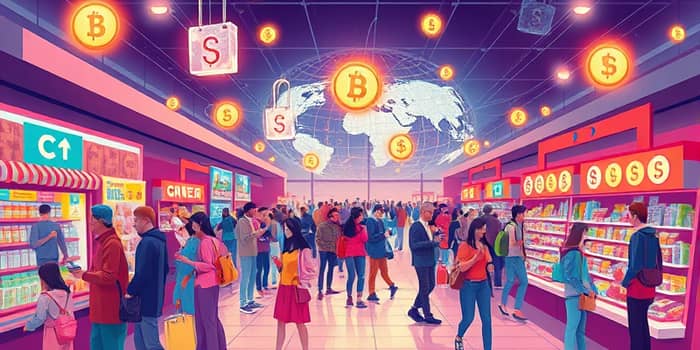
As global retail and digital finance converge, three fast-growing areas are reshaping commerce. E-commerce on the blockchain sits at the intersection of global online retail, blockchain/Web3 infrastructure, and decentralized commerce, promising to unlock new levels of trust, efficiency, and innovation.
This article explores the massive market opportunity, core building blocks, transformative benefits, real-world use cases, and emerging trends that position blockchain as the next evolutionary layer of online retail.
Macro Context: Market Size and Growth
Over 3 billion people now shop online, driving e-commerce sales to a staggering $6.42 trillion entering 2026. This scale reflects unprecedented global digital spending and underscores how intertwined online retail has become with everyday life.
Key growth drivers include:
- Mobile commerce and app-based shopping experiences
- Social commerce on networks and live-stream platforms
- Cross-border transactions and global logistics
- B2B e-commerce expansion among enterprises
Meanwhile, the blockchain technology market is estimated at $41.14 billion in 2025 and projected to skyrocket to $911.74 billion by 2035, reflecting a high double-digit CAGR and massive infrastructure build-out. Within the retail niche, cryptocurrency use in e-commerce generated $478.4 million in revenue in 2024 and is forecast to reach $1,074.7 million by 2030 at a 14.8% CAGR.
Decentralized e-commerce platforms alone accounted for $13.12 billion in 2025, expected to grow to $54.38 billion by 2030 at a 32.9% CAGR. These numbers highlight accelerating adoption of blockchain and growing consumer appetite for peer-to-peer marketplaces.
Core Concepts: Understanding Blockchain E-commerce
At its foundation, blockchain is a distributed, decentralized, tamper-resistant ledger where transactions are cryptographically linked in blocks. Its key features—immutability, transparency, consensus, and the absence of a single controlling authority—enable new commerce paradigms beyond traditional platforms.
Decentralized marketplaces leverage this technology to facilitate secure, transparent, peer-to-peer transactions without a central intermediary. Buyers pay with cryptocurrencies or stablecoins, smart contracts enforce order and escrow terms, and token-based governance aligns incentives across the network.
- Smart contracts: self-executing code for payments, shipping, refunds, and rewards
- Utility tokens: platform-specific currencies for payments, governance, and staking
- On-chain digital identity: verifiable credentials that streamline compliance
- Tokenized assets: digital or physical goods represented as tradable tokens
How Blockchain Revolutionizes Online Retail
Blockchain integration transforms every stage of the customer journey. In payments, merchants benefit from lower transaction costs by bypassing banks and card networks. Irreversible, cryptographically signed transactions minimize chargebacks and fraud, while stablecoins enable near-real-time, borderless settlement across continents.
Security and privacy receive a boost through decentralized data management. Customer information need only be shared on a need-to-know basis, reducing central points of failure and dramatically lowering breach risks. Such architectures also facilitate regulatory compliance with GDPR, CCPA, and other data protection laws.
Supply chain transparency becomes real-time with blockchain’s immutable records. From raw materials to finished goods, each logistical step is recorded on-chain, providing real-time provenance tracking and slashing administrative overhead. Consumers can verify authenticity with a quick scan, thwarting counterfeits in luxury, pharmaceuticals, or ethically sourced products.
Loyalty and engagement reach new heights through tokenized programs. Brands like NEXT BASKET have introduced the NEBA Token, a Web3 utility token that powers secure, tamper-proof loyalty points and merchant-funded rewards. Customers earn crypto rewards directly in their wallets, while merchants enjoy reduced operational costs.
Emerging business models include peer-to-peer marketplaces where sellers connect directly with buyers, reducing platform commissions and gatekeeper power. NFTs and tokenized digital goods—ranging from virtual fashion to in-game items—are traded seamlessly, with smart contracts automating creator royalties on every resale. Headless commerce architectures allow brands to integrate these blockchain features without a full front-end overhaul, blending new technology into familiar shopping experiences.
Detailed Use Cases and Examples
Product provenance is especially valuable for industries requiring strict traceability. Food and pharmaceutical companies use blockchain to track batch numbers and certifications, enabling swift recalls and quality audits. A consumer scanning a QR code gains instant access to farm origin, processing dates, and shipping logs.
Smart contract–based escrow services automate payments and refunds. When a buyer confirms receipt, funds are released to the seller without manual intervention. Dispute resolution clauses can be encoded directly into the contract, streamlining customer support and building confidence.
Token-driven loyalty programs offer interoperability across partnered brands. Shoppers can accumulate tokens at multiple vendors and redeem them in a unified ecosystem, driving cross-promotion and deeper engagement. Fraud is virtually eliminated thanks to cryptographic proof of ownership.
Digital art and virtual fashion leverage NFTs to grant verifiable ownership and programmable royalties. Secondary market sales instantly trigger royalty distributions to original creators, ensuring ongoing revenue streams and fostering a creator-centric economy.
Cross-border D2C brands are adopting stablecoins to eliminate currency conversion delays. Small and medium-sized merchants gain access to a global audience without the friction of correspondent banking, unlocking markets previously unreachable.
Future Trends and What Comes Next
The convergence of blockchain with AI, IoT, and immersive technologies like AR/VR promises unprecedented transparency and dynamic shopping experiences. Smart warehouses, automated replenishment, and predictive logistics will become commonplace as data flows seamlessly across decentralized networks.
- Decentralized identity for seamless onboarding
- Fractional ownership of high-value assets
- Sustainable supply chains with tokenized carbon credits
- AI-driven personalization powered by on-chain data
- Interoperable loyalty ecosystems spanning multiple platforms
Regulatory clarity and standards development will accelerate institutional adoption, while Layer 2 solutions and cross-chain protocols will drive down costs and boost throughput. As consumers and merchants embrace these innovations, we will witness the birth of a truly borderless, trustless, and efficient digital marketplace.
In this era of rapid change, blockchain is not merely a technological novelty—it is the foundation of a more equitable and empowered commerce ecosystem. By uniting transparency, security, and direct peer-to-peer engagement, e-commerce on the blockchain offers a compelling vision: one where consumers and creators reclaim control, and every transaction carries the promise of a fairer, more resilient global economy.
References
- https://www.cloudi5.com/blog/how-e-commerce-can-benefit-from-blockchain-technology--310
- https://www.thebusinessresearchcompany.com/report/decentralized-e-commerce-platforms-market-report
- https://www.bigcommerce.com/articles/ecommerce/blockchain-ecommerce/
- https://www.einpresswire.com/article/893673907/trends-and-analysis-of-the-decentralized-e-commerce-platforms-market-by-application-segment-with-forecasts-to-2030
- https://virtocommerce.com/blog/pros-and-cons-of-blockchain-in-ecommerce
- https://www.grandviewresearch.com/horizon/statistics/cryptocurrency-market/end-use/retail-e-commerce/global
- https://biztechmagazine.com/article/2019/10/benefits-blockchain-e-commerce
- https://www.fortunebusinessinsights.com/industry-reports/blockchain-market-100072
- https://www.spydra.app/blog/future-of-online-shopping-how-blockchain-benefits-e-commerce
- https://www.precedenceresearch.com/blockchain-technology-market
- https://elogic.co/blog/blockchain-for-e-commerce-not-by-crypto-alone/
- https://tblocks.com/articles/e-commerce-trends/
- https://www.swisslog.com/nl-nl/case-studies-en-brochures/blog/benefits-of-blockchain-in-e-commerce
- https://www.flowlu.com/blog/productivity/ecommerce-statistics/
- https://inviqa.com/blog/introduction-blockchain-ecommerce