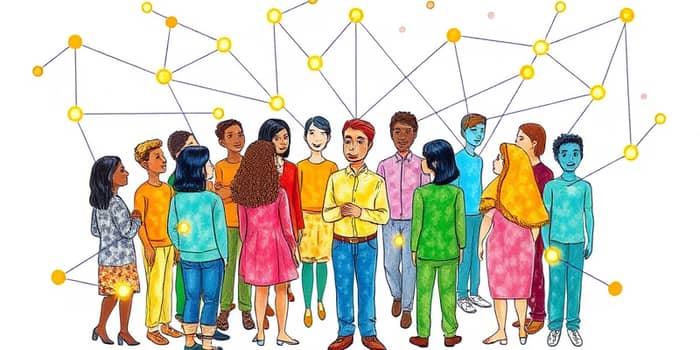
In an era defined by rapid change and complex challenges, traditional hierarchical structures often struggle to adapt. A new paradigm is emerging where power is shared, voices are amplified, and communities themselves become the driving force for innovation and resilience.
Defining Decentralized Governance
At its core, decentralized governance redistributes authority away from a single central entity toward a broader network of participants. This model emphasizes distributed power and transparency, enabling organizations and societies to respond more effectively to shifting circumstances.
Historically, governance models have evolved from monarchies to representative republics, but contemporary applications extend far beyond nation-states. Academic studies describe decentralized governance as a dynamic, adaptive system of distributed authority, characterized by networked communication, emergent properties, and decentralized decision-making nodes.
Key elements include:
- Distribution of power—avoiding single points of failure or control.
- Transparency and openness—building trust through visible processes and data.
- Community participation—ensuring diverse perspectives are heard.
- Autonomy and self-organization—empowering local sub-units to adapt on the ground.
Community as a Form of Capital
When governance is decentralized, the community itself transforms into a core productive asset. Members’ engagement, knowledge, and relationships become capital—resources that fuel collective action and innovation.
We can frame community capital in four dimensions:
- Social capital: trust, norms, and networks that enable cooperation and coordination.
- Political capital: bargaining power and influence gained through local decision-making.
- Knowledge capital: context-specific insights and rapid problem-solving capacity.
- Innovation capital: bottom-up experimentation that accelerates new solutions.
In decentralized systems, the community is not merely consulted—it governs. This shift elevates participants from stakeholders to indispensable assets.
Benefits, Risks, and Empirical Evidence
Decentralization and community-driven governance deliver tangible advantages across sectors, though they require careful design to mitigate risks.
Public Sector and Local Governance
Studies in development and governance reveal that shifting authority to local entities often leads to increases local trust and engagement. Citizens gain direct input on budgets, policies, and service delivery, resulting in:
- Greater responsiveness to community needs.
- Improved efficiency in local public services.
- Enhanced accountability through visible decision pathways.
The OECD reports that in two-thirds of member countries, decentralization has increased the economic weight of subnational governments, as measured by shares of public expenditure and employment.
Health Outcomes and Spending
An empirical OECD study discovered a non-linear relationship between administrative decentralization and healthcare performance. Moderate decentralization correlates with lower public spending and higher life expectancy, while excessive fragmentation erodes efficiency.
This data underscores that governance design must balance autonomy with coordination to maximize public good.
Organizational and Business Advantages
Within companies, decentralized models foster faster decision-making and greater agility. Teams empowered to act swiftly can respond to crises, tailor solutions, and iterate without bureaucratic bottlenecks.
Examples include global firms that empower regional managers to address product recalls or service outages immediately, preserving reputation and customer trust. Additionally, employee engagement soars when individuals feel their contributions shape outcomes directly.
Web3 and Blockchain Innovations
In digital ecosystems, community governance is encoded on-chain. Decentralized Autonomous Organizations (DAOs) use smart contracts to automate voting, fund distribution, and protocol changes.
Different governance mechanisms include:
- Council-based governance: elected bodies represent community interests.
- Token-based voting: stakeholders use governance tokens to decide proposals.
- Expressive representation: signaling mechanisms guide policy without binding mandates.
These models deliver full transparency—every vote and proposal is recorded on a public ledger—and enable global, inclusive participation without geographical or institutional barriers.
Application Across Domains
Beyond blockchain and corporate structures, decentralized governance finds applications in:
- Public policy: multi-level governance in environmental and urban planning.
- Data management: federated data governance aligning local control with global standards.
- Sustainability networks: polycentric models addressing climate resilience.
In each domain, communities leverage local knowledge, build trust, and act autonomously, turning participation into measurable outcomes.
Implementing Community-Centric Governance
For organizations and policymakers seeking to adopt decentralized governance, essential steps include:
- Establishing clear governance frameworks that define roles and decision pathways.
- Investing in capacity building to ensure participants can engage effectively.
- Maintaining open communication channels and transparent data repositories.
By viewing the community as capital rather than a passive audience, leaders can unlock unprecedented capacity for collective action and create resilient systems capable of meeting complex challenges.
As we face global issues from public health to digital transformation, embracing decentralized governance offers a path toward more inclusive, adaptive, and sustainable futures. Communities, empowered with authority and resources, become the most valuable asset any system can possess.
References
- https://pollution.sustainability-directory.com/term/decentralized-governance/
- https://pmc.ncbi.nlm.nih.gov/articles/PMC8520686/
- https://community.trustcloud.ai/docs/grc-launchpad/grc-101/governance/decentralized-governance-exploring-the-role-of-blockchain-in-modern-organizations/
- https://www.rrojasdatabank.info/decentlimits.htm
- https://www.velotix.ai/glossary/decentralized-data-governance/
- https://data.world/blog/decentralized-data-governance/
- https://freemanlaw.com/decentralized-governance-mechanisms/
- https://www.functionly.com/orginometry/decentralized-org-structure
- https://trustcloud.tech/blog/decentralized-governance-a-promising-democratic-tool-in-the-network/
- https://www.weforum.org/stories/2024/06/decentralized-not-fragmented-new-way-think-about-operations/
- https://www.oecd.org/en/publications/2019/03/making-decentralisation-work_g1g9faa7.html
- https://www.runn.io/blog/decentralized-organizations
- https://www.brookings.edu/articles/idea-to-retire-decentralized-it-governance/