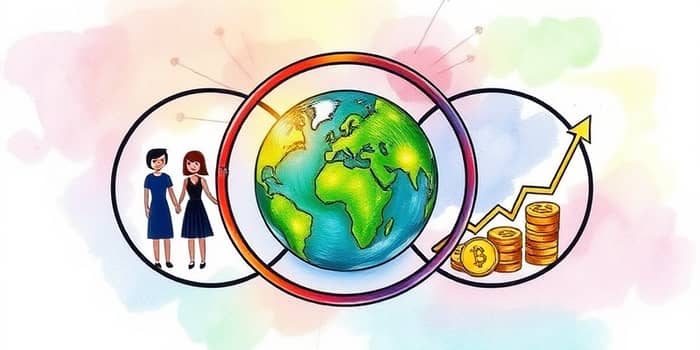
In an era of rapid change and global challenges, businesses must evolve beyond traditional profit measures. Companies embracing a holistic financial perspective can unlock new opportunities, deeper impact, and transformative shift in measuring success.
This article explores the triple bottom line framework—people, planet, profit—and offers practical guidance for organizations ready to thrive sustainably.
The Origins of the Triple Bottom Line
Introduced in 1994 by John Elkington, the triple bottom line (TBL) redefined business success. Rather than focusing solely on financial returns, it insisted organizations measure their social and environmental footprints equally.
This concept sparked a paradigm shift in business, encouraging leaders to see long-term resilience as inextricably linked to community wellbeing and ecological health.
Understanding the Three Pillars
The power of the triple bottom line lies in its three interconnected pillars—often called the “three P’s.” Each pillar demands careful stewardship to create balanced and lasting impact.
By integrating profit, people, and planet, organizations cultivate robust systems where gains in one area support breakthroughs in others.
Why Holistic Financial Planning Matters
Traditional accounting isolates financial performance, often sidelining broader impacts. Holistic financial planning breaks these silos, aligning every decision with a unified vision of sustainable prosperity.
With global markets and consumer values shifting, stakeholders increasingly demand transparency on social and environmental outcomes alongside financial health. Companies that ignore this trend risk reputational damage, talent loss, and missed opportunities.
Adopting a triple bottom line mindset positions businesses to:
- Enhance brand loyalty through authentic commitment to shared values
- Improve risk management by anticipating regulatory and market shifts
- Attract and retain passionate talent seeking purpose-driven work
- Unlock new markets and partnerships aligned with sustainability goals
Implementing the Triple Bottom Line
Moving from theory to practice requires a clear, step-by-step approach. Start by embedding TBL principles into your core strategy, then operationalize them across functions.
Consider the following roadmap:
- Assess current impacts: Conduct a comprehensive audit of social, environmental, and financial performance.
- Set measurable goals: Define targets for community wellbeing, carbon reduction, and revenue growth.
- Empower cross-functional teams: Foster collaboration between finance, HR, operations, and sustainability departments.
- Integrate metrics: Embed TBL indicators into executive dashboards and performance reviews.
- Communicate transparently: Share progress and obstacles with stakeholders to build trust and accountability.
This process not only drives building resilient and equitable futures but also delivers tangible returns through efficiency gains and stronger stakeholder engagement.
Overcoming Common Challenges
Adopting a holistic framework is rewarding but not without obstacles. Organizations often struggle with measurement, culture, and short-term pressures.
- Establishing meaningful metrics across diverse areas
- Aligning departmental priorities and budgets
- Managing investor expectations focused on quarterly profits
- Driving organizational culture change at all levels
Overcoming these hurdles demands leadership commitment, continuous education, and a willingness to experiment. Celebrating small wins builds momentum and demonstrates progress to skeptics.
Real-World Success Stories
Leading companies around the globe prove the power of the triple bottom line. Interface, a global carpet tile manufacturer, revolutionized its industry by designing products for recyclability, slashing waste while boosting profits.
Unilever’s Sustainable Living Plan drove significant reductions in greenhouse gas emissions and water usage, all while growing market share. Natura, the Brazilian cosmetics pioneer, demonstrated that prioritizing people and planet can enhance brand prestige and financial performance simultaneously.
These examples illustrate how fostering innovation and long-term sustainability ignites growth and deepens positive impact.
Practical Steps to Begin Your Journey
Ready to elevate your organization? Here are actionable next steps:
- Engage stakeholders: Host workshops with employees, suppliers, and community members to gather insights.
- Pilot small initiatives: Test renewable energy projects, fair trade sourcing, or community outreach programs.
- Track progress: Use simple scorecards to monitor key TBL indicators quarterly.
- Scale successes: Expand pilot projects that deliver measurable benefits across all three pillars.
- Share your story: Publicize achievements and lessons learned to inspire others and attract like-minded partners.
By taking these steps, you begin empowering every stakeholder in society and shaping a more resilient enterprise.
Conclusion
The triple bottom line framework is more than an accounting tool; it’s a philosophy that reshapes how we define success. When businesses prioritize social equity, ecological health, and financial viability equally, they become engines of sustainable prosperity.
Adopt holistic financial planning to unlock new levels of innovation, stakeholder loyalty, and risk resilience. Embrace this journey today to create interconnected systems thinking approach within your organization and contribute to a thriving global community.
Beyond the bottom line lies a future where business success and positive impact are inseparable—where doing well and doing good become one and the same.
References
- https://blog.massmutual.com/planning/life-financial-holistic-planning
- https://rheaply.com/blog/triple-bottom-line/
- https://www.justvanilla.com/blog/what-is-holistic-financial-planning
- https://commonthread.antioch.edu/beyond-profit-understanding-the-triple-bottom-line-approach/
- https://emoneyadvisor.com/blog/what-is-holistic-financial-planning/
- https://www.thecorporategovernanceinstitute.com/insights/lexicon/what-is-the-triple-bottom-line/
- https://smartasset.com/financial-advisor/holistic-financial-planning
- https://uwex.wisconsin.edu/stories-news/triple-bottom-line/
- https://centurawealth.com/blog/five-reasons-why-holistic-planning-is-important/
- https://online.hbs.edu/blog/post/what-is-the-triple-bottom-line
- https://privatewealth-insights.bmo.com/en/insights/wealth-planning-and-strategy/how-a-holistic-financial-plan-can-help-you-protect-your-wealth/
- https://www.ibrc.indiana.edu/ibr/2011/spring/article2.html
- https://www.bankatfirst.com/personal/discover/flourish/holistic-financial-planning.html
- https://www.youtube.com/watch?v=1-Ct_53XKYY
- https://www.theprivateoffice.com/insights/holistic-financial-planning