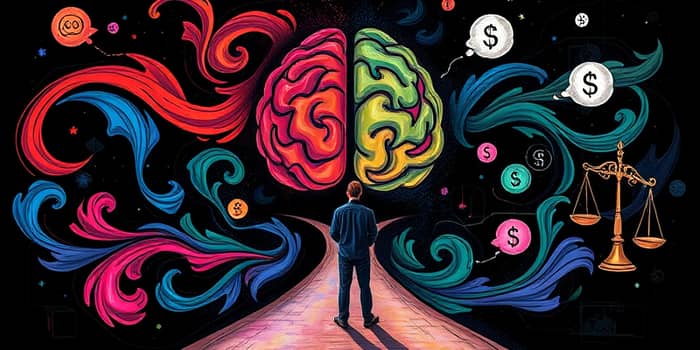
We often believe our financial choices are purely logical, but beneath the surface, emotions and mental shortcuts steer much of how we handle money. Behavioral finance reveals these hidden forces and offers a path to more mindful habits.
What Is Behavioral Finance?
At its core, behavioral finance studies how emotions drive decisions. Unlike traditional models that assume investors are perfectly rational, this field merges psychology and economics to explain why people make systematic errors when managing money.
Traditional finance paints a picture of individuals as rational, utility-maximizing agents who analyze every data point before acting. In contrast, behavioral finance acknowledges that we rely on mental shortcuts (heuristics) and are swayed by psychological influences, emotions, and cognitive biases. These forces shape habits like panic-selling during downturns, under-saving for retirement, or overspending on credit.
The Roots of Behavioral Finance
Understanding today’s insights requires a look back at pioneering thinkers. In 1841, Charles Mackay published “Extraordinary Popular Delusions and the Madness of Crowds,” dissecting bubbles fueled by collective euphoria.
Fast forward to 1979, when Daniel Kahneman and Amos Tversky introduced Prospect Theory. They demonstrated that individuals evaluate gains and losses relative to a mental reference point and experience losses more intensely than gains—a phenomenon now known as loss aversion, a cornerstone of behavioral finance.
Building on these findings, Richard Thaler explored concepts like mental accounting and self-control, showing how people compartmentalize money into “buckets” (salary vs. bonus) and struggle to align immediate desires with long-term goals.
How Your Brain Really Sees Money
Prospect Theory reveals four key principles that govern our perception of financial outcomes:
Reference dependence: We judge wealth gains or losses against personal benchmarks (purchase price, last year’s income), not absolute values.
Loss aversion: A loss generally feels over twice as painful as an equivalent gain feels pleasurable. Experiments show most people require around $20 of potential gain to accept a 50/50 chance of losing $10.
Diminishing sensitivity: The subjective impact of each additional dollar diminishes as amounts grow. Losing $100 hurts more than the extra pain of losing from $10,000 to $10,100.
Probability weighting: We overweight rare events and underweight moderate-to-high probabilities, explaining why we both buy lottery tickets and skip adequate insurance coverage.
Major Biases That Shape Financial Choices
Our daily money habits often spring from well-documented biases. The table below summarizes a few of the most powerful:
Everyday Money Habits Explained
Let’s connect these biases to real-world behaviors:
1. Overspending with credit cards: Easy access to plastic, combined with mental accounting, makes spending feel less “real.” Present bias and self-control challenges push many toward impulse purchases.
2. Under-saving for retirement: Complexity and procrastination, fueled by hyperbolic discounting, lead to low participation in employer plans. Even when matching contributions are offered, many delay or opt out.
3. Panic selling during downturns: Fear of further losses triggers a disposition effect—selling winners too soon and holding losers too long. Loss aversion locks in regret.
4. Chasing hot stocks: Overconfidence and availability bias tempt investors to buy recent winners at their peaks. Herding amplifies speculative frenzies, from dot-com mania to meme-stock rallies.
5. Home bias: Familiarity feels safe, so many concentrate portfolios in local markets, sacrificing diversification and potential gains.
Practical Strategies to Master Your Money Habits
Recognizing biases is the first step. Next, adopt concrete techniques to counteract them:
- Automate savings and investments, setting predefined contribution schedules to bypass procrastination.
- Establish clear financial goals and track progress using apps or spreadsheets to counter present bias and enhance accountability.
- Practice a cooling-off period for major purchases to curb impulse spending and emotional reactions.
- Diversify systematically through low-cost index funds to mitigate overconfidence and home bias.
- Use decision rules—sell if price drops by a fixed percentage or rebalance quarterly—to overcome loss aversion and anchoring.
Conclusion: Embrace Awareness and Action
Behavioral finance teaches that our money habits are not irrational quirks but predictable patterns etched by human nature. By shining a light on these hidden forces, we gain the power to reshape our financial lives.
Start today: identify one bias that most affects your decisions, choose a countermeasure from the strategies above, and monitor the impact. Over time, small, consistent adjustments—guided by self-awareness—can transform impulsive spending into thoughtful stewardship, panic into patience, and missed opportunities into long-term growth.
Remember, mastering your money habits is not about eliminating emotions; it’s about aligning them with your highest aspirations. With practice, preparation, and persistence, you can harness behavioral insights to build a more secure and fulfilling financial future.
References
- https://www.indeed.com/career-advice/career-development/behavioral-finance
- https://www.iibsonline.com/case-study-details/the-impulse-to-sell-a-behavioral-finance-case-study
- https://online.mason.wm.edu/blog/what-is-behavioral-finance
- https://www.scribd.com/document/484786988/Case-study-Behavioral-Finance
- https://www.merceradvisors.com/insights/investing/what-is-behavioral-finance-and-how-can-it-impact-investing-decisions/
- https://www.eelet.org.uk/index.php/journal/article/view/2522
- https://www.edelmanfinancialengines.com/education/financial-planning/behavioral-finance/
- https://en.wikipedia.org/wiki/Behavioural_finance
- https://www.kaplanfinancial.com/resources/career-advancement/behavioral-finance
- https://www.ebsco.com/research-starters/economics/behavioral-finance
- https://enrichpartners.com/blog/covid-19-created-the-perfect-case-study-in-behavioral-finance-heres-what-we-mean
- https://www.creighton.edu/blog/what-behavioral-finance